Foundation of Large Language Model
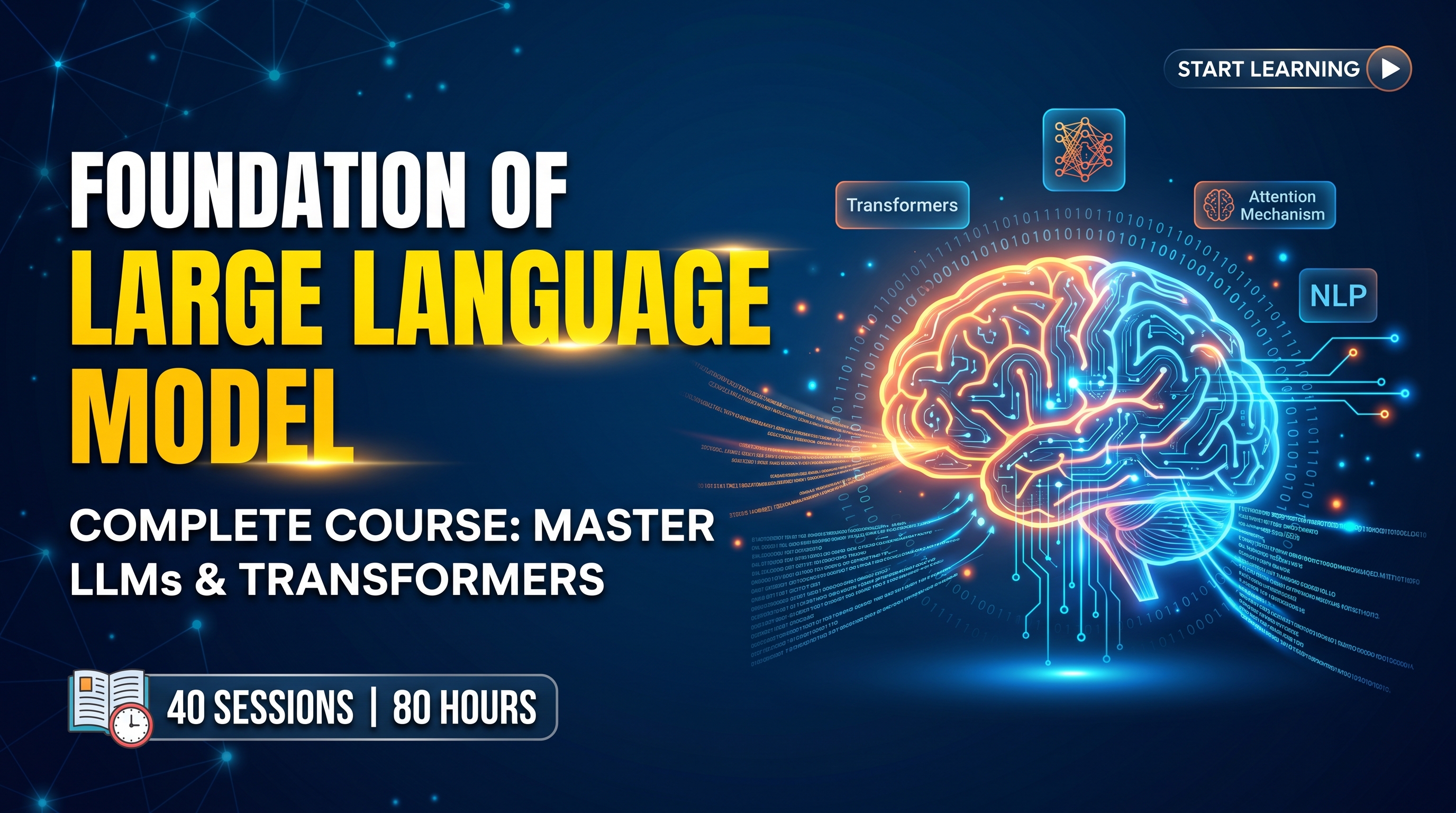
The "Foundation of Large Language Model" course is designed to provide a comprehensive understanding of the fundamental concepts and architectures that underpin large language models (LLMs). This course is ideal for well-educated individuals who are eager to delve into the intricacies of natural language processing and machine learning, particularly in the context of LLMs.
Over the span of 40 class sessions, each lasting 2 hours, learners will explore a wide array of topics essential to mastering the field of large language models. The course begins with an introduction to the basic units of text processing in NLP, distinguishing between 'tokens' and 'words', and progresses to more complex topics such as encoder-decoder networks and feedforward neural language modeling.
Key topics include:
- Tokenization and NLP Basics: Understanding the process of breaking down text into tokens and the significance of tokens in language models.
- Encoder-Decoder Architectures: Exploring the structure and function of encoder-decoder networks, including their application in NLP tasks through the text-to-text framework.
- Self-Attention Mechanisms: Delving into the generation of query, key, and value vectors, and the role of self-attention in transformer models.
- Transformer Models: Detailed study of transformer encoding and decoding, including the core components and architectural adaptations for long sequences.
- Language Modeling Techniques: Examining standard and masked language modeling, hierarchical softmax, and the application of rotary positional embeddings.
- Reinforcement Learning and LLMs: Understanding the application of reinforcement learning in LLMs, including the concepts of actions, environments, and policy learning.
- Fine-Tuning and Adaptation: Exploring methods for adapting LLMs to specific tasks, including standard fine-tuning, prefix fine-tuning, and parameter-efficient techniques.
- LLM Alignment and Safety: Discussing the importance of aligning LLMs with human values and enhancing their safety through alignment techniques.
Throughout the course, learners will engage in hands-on activities and projects that reinforce theoretical knowledge with practical application. By the end of the course, participants will have a robust understanding of the foundational principles of large language models, equipping them with the skills necessary to engage with advanced NLP tasks and contribute to the development of cutting-edge language technologies.
Adaptive
Varies by mastery
18 domains
How the course works
A session is a short study-and-practice checkpoint, not a fixed class meeting. The course can move faster when material is already familiar and slow down when a topic needs more practice.
Study a focused page
Read a small prerequisite-ordered set that gives the context for the next practice step.
Check understanding
Answer linked questions so the system can tell what is already strong and what needs review.
Keep moving
Unlock the next set after the current material is understood, with review scheduled as needed.
Who this course is for
Students, educators, researchers, and professionals with basic familiarity with programming or machine learning who want to understand how large language models work beyond prompt use, including tokenization, neural language modeling, transformers, fine-tuning, retrieval-augmented generation, and alignment.
Objectives
- Understand the distinction between 'tokens' and 'words' in NLP and their significance in language models.
- Master the process of tokenization and its application in breaking down text into fundamental units for NLP tasks.
- Analyze the architecture and function of encoder-decoder networks, including their application in NLP tasks through the text-to-text framework.
- Explore the generation of query, key, and value vectors in self-attention mechanisms and their role in transformer models.
- Examine the core components and architectural adaptations of transformer models for processing long sequences.
- Apply feedforward neural language modeling techniques to predict upcoming words from prior word context.
- Implement hierarchical softmax for efficient probability computation over large vocabulary sets.
- Understand the application of rotary positional embeddings to token embeddings in language models.
- Explore the role of reinforcement learning in LLMs, including actions, environments, and policy learning.
- Investigate standard and masked language modeling techniques and their application in NLP tasks.
- Develop skills in fine-tuning and adapting LLMs to specific tasks using standard and parameter-efficient techniques.
- Discuss the importance of aligning LLMs with human values and enhancing their safety through alignment techniques.
- Engage in hands-on activities and projects to reinforce theoretical knowledge with practical application.
- Evaluate the effectiveness of different language modeling techniques in various NLP tasks.
- Identify and mitigate common challenges in LLM alignment and safety.
- Apply knowledge of transformer encoding and decoding to design and implement NLP solutions.
- Understand the limitations of prompting without foundational knowledge and strategies to address them.
- Explore the use of retrieval-augmented generation (RAG) to enhance LLM performance with external data sources.
- Analyze the impact of scaling laws on the development and performance of LLMs.
- Discuss ethical considerations and privacy concerns in the development and deployment of LLMs.
Syllabus
Encoder-decoder networks
Applying Encoder-Decoder Architectures to NLP via the Text-to-Text Framework
Seq2seq Models for Text Generation
Generation of Query, Key, and Value Vectors in Self-Attention
General Attention Formula
Improved Multi-Head Attention Mechanism
Transformer Encoding
Transformer Decoder
Feedforward Neural Language Modeling
Hierarchical Softmax
Standard Language Modeling
Masked Language Modeling
Reinforcement Learning
Action in the Context of LLMs
Environment in the Context of LLMs
Standard Fine-Tuning
Prefix Fine-Tuning
Motivation for Parameter-Efficient Fine-Tuning
Enhancing LLM Safety through Alignment
Challenges in LLM Alignment
Desirable Attributes of Aligned LLMs
Retrieval-Augmented Generation (RAG)
Scaling Laws as a Fundamental Principle in LLM Development
Emergent Abilities in LLMs
References
These are the external source domains cited by nodes tagged for this course. Each source is shown once, with the number of tagged-node citations from that source in parentheses.