
Learn Before
Examples of Low and High Variability
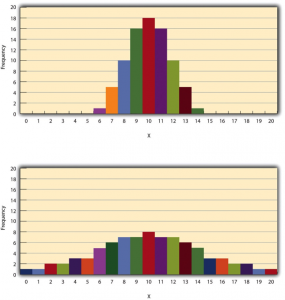
Two distributions can share the identical central tendency (such as the same mean, median, and mode) yet possess entirely different variability. A distribution with low variability has scores clustered closely around the center, while one with high variability has scores spread across a much broader range.
0
1
Tags
KPU
Research Methods in Psychology - 4th American Edition @ KPU
Related
Examples of Low and High Variability
What does the variability of a set of scores describe?
In a psychological study, if two different groups of participants have identical average scores, they will also necessarily have the same degree of variability in their results.
Rank the following research study outcomes in order from the distribution with the lowest variability (1) to the distribution with the highest variability (3).
In psychological statistics, the term 'variability' describes the extent to which individual scores in a distribution differ or spread out around the average.
A psychology researcher finds that two groups of participants have the same mean score of on a memory task, but Group A has much higher variability than Group B. What does this indicate about the scores in Group A?
A psychologist evaluates two clinical trials that both achieved an average improvement score of points. Trial A has scores that cluster tightly around the average, while Trial B has scores ranging widely from to points of improvement. The psychologist judges the average for Trial B to be misleading when predicting individual outcomes because of the high _____ within its distribution.
A psychology researcher measures the reaction times (in milliseconds) for three different groups. All three groups have an identical mean reaction time of ms, but their distributions differ. Match each group's scores to the analytical conclusion that best describes its variability and the representativeness of the mean.
A cognitive psychologist measures the number of words recalled from a list of items by participants in three different study conditions. In all three conditions, the average (mean) recall score is exactly words. Match each condition's actual dataset to the description of its variability relative to the others.
A developmental psychologist is studying the age (in months) at which infants first begin to walk. She compares two distinct groups of infants:
- Group 1: ages are [9, 10, 11, 12, 13] months, with a mean of months.
- Group 2: ages are [6, 8, 11, 14, 16] months, with a mean of months.
When analyzing these datasets, the psychologist notes that while the central tendency is identical, the individual scores in Group 2 are far more dispersed. To determine which group's average
A research team is evaluating three different psychological datasets to determine how well each group's mean represents the performance of individual participants.
Arrange these research scenarios in order from the dataset where the group mean is the least representative (highest variability) of individual scores to the dataset where the group mean is the most representative (lowest variability) of individual scores.
Learn After
Which of the following best characterizes a distribution with high variability?
Based on the provided image, the distribution represented by the taller, narrower curve has a lower level of variability than the distribution represented by the shorter, wider curve, even though they share the same mean.
A researcher measures 'reaction time' in two different groups on a cognitive task. Both groups have an identical mean of 300 milliseconds. In Group A, the scores are tightly clustered (ranging from 290ms to 310ms). In Group B, the scores are spread across a much broader range (ranging from 100ms to 500ms). Referring to the provided image of two distributions, match each research observation to its corresponding statistical characteristic.
A researcher is measuring 'Stress Levels' (on a scale of 1-10) across three different treatment groups, all of which resulted in an identical mean score of 5. Analyze the visual data in the provided image along with the scenario descriptions to arrange the groups in order from the lowest variability (position 1) to the highest variability (position 3).
You are designing a high-precision experimental study on human reaction times. Your goal is to create a research protocol that minimizes extraneous variables so that your results resemble the taller, narrower curve in the provided image. Which of the following design strategies should you implement to achieve this low-variability outcome?
Two distributions share the same mean of 10, but the first has scores clustered tightly around the center while the second has scores spread across a much broader range. A researcher concludes that the mean is a less representative summary of the 'typical' participant in the second distribution because its scores possess _____ variability.
Match each variability concept with the description that best represents it.
A researcher collects final exam scores from two different sections of an introductory psychology course. Both sections have a mean of 78, a median of 78, and a mode of 78. The researcher concludes that because all three measures of central tendency are identical, the two score distributions must look identical when graphed. Based on what you know about central tendency and variability, this conclusion is correct.
A clinical researcher compares two therapy groups on a standardized well-being scale. Group A and Group B both show a mean score of 60, yet when the researcher graphs the two distributions, Group A's curve is tall and narrow while Group B's curve is short and flat. This difference in shape reveals that Group A has _____ variability than Group B, meaning its individual scores deviate less from the mean.
A researcher wants to evaluate which of two newly developed psychological assessment tools produces more consistent scores. Both tools yield the same mean, median, and mode of 50 across a sample of 100 participants, so central tendency cannot differentiate them. Arrange the following steps in the order that best reflects a sound, justified evaluation of the two tools' variability.
Define the concepts of low and high variability as they relate to frequency distributions. In your explanation, describe how two distributions can compare in terms of their central tendency (mean, median, and mode) versus their variability.
Based on this scenario, diagnose the relationship between central tendency and variability for the two groups. Contrast the distributions of Group A and Group B using the concepts of low and high variability.
Suppose you are comparing the final exam scores of two psychology classes. Both classes have an identical mean, median, and mode of 75. Class 1 has low variability, while Class 2 has high variability. Apply the concepts of low and high variability to describe what the spread of student scores looks like in each class.