
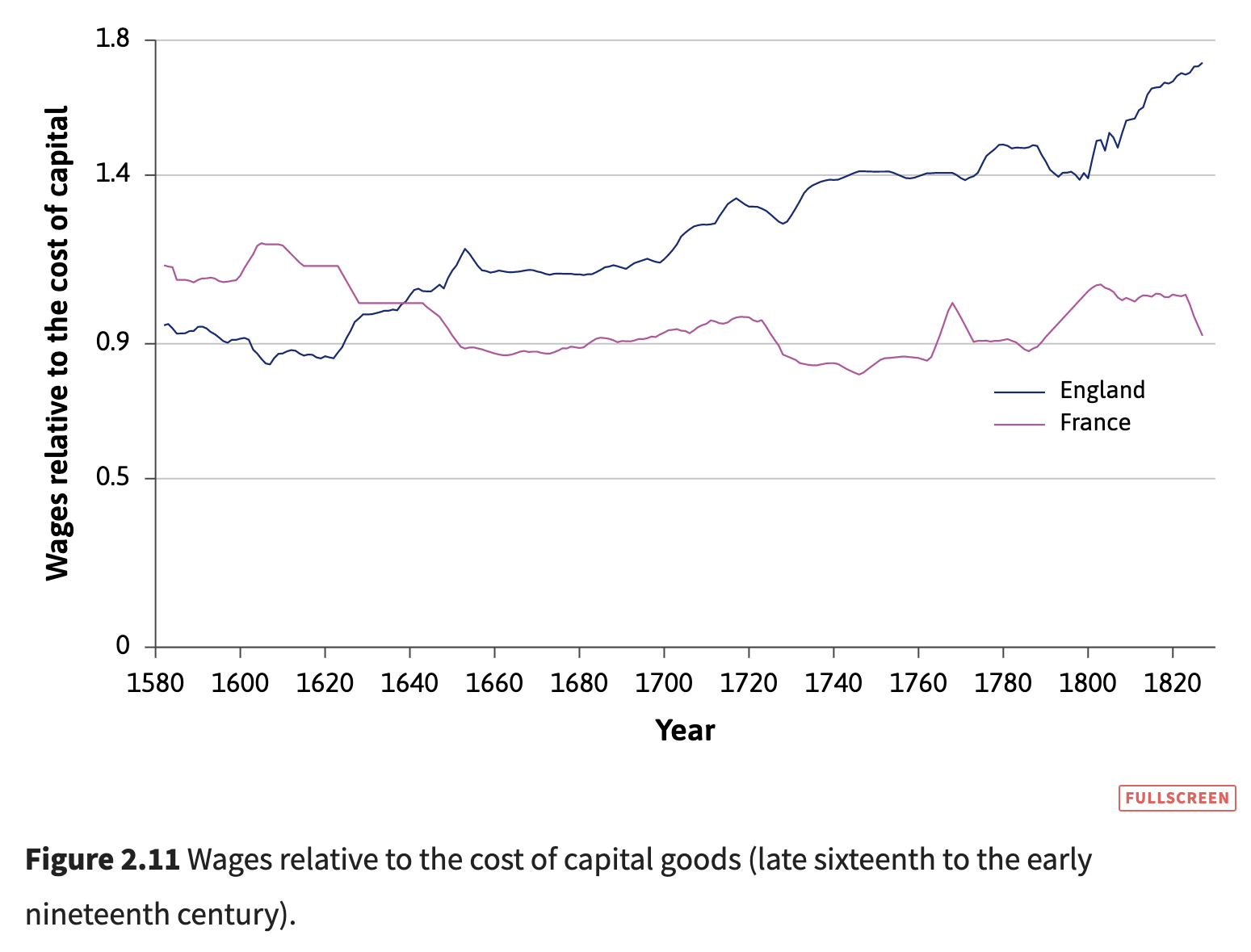
Figure 2.13: Wages Relative to the Cost of Capital Goods in England and France (Late 16th to Early 19th Century)
This figure presents a comparison of the ratio of laborers' wages to the cost of using capital goods in England and France from the late 1500s to the early 1800s. While this ratio was comparable in both nations during the mid-17th century, it began to diverge afterward. In England, labor became progressively more expensive relative to capital, creating a growing economic incentive to substitute workers with machinery. This trend was not observed in France, where, conversely, the incentive for labor-saving innovation was actually stronger in the late 16th century than it was two centuries later.
0
1
Contributors are:


Who are from:


Tags
History
Humanities
Economics
Social Science
Empirical Science
Science
Economy
CORE Econ
The Economy 1.0 @ CORE Econ
Ch.1 The Capitalist Revolution - The Economy 1.0 @ CORE Econ
Ch.2 User-centered design process - User Experience Design - Winter 23 @ UI Design in UI @ University of Michigan - Ann Arbor
UI Design in UI @ University of Michigan - Ann Arbor
User Experience Design - Winter 23 @ UI Design in UI @ University of Michigan - Ann Arbor
UI @ University of Michigan - Ann Arbor
User Experience Design @ UI Design in UI @ University of Michigan - Ann Arbor
University of Michigan - Ann Arbor
Introduction to Microeconomics Course
Ch.2 Technology and incentives - The Economy 2.0 Microeconomics @ CORE Econ
The Economy 2.0 Microeconomics @ CORE Econ
Related
Invariance of Index Graph Shape to Reference Period
Figure 2.13: Wages Relative to the Cost of Capital Goods in England and France (Late 16th to Early 19th Century)
Constructing a Nominal Wage Index
An economic index is created to track the price of a specific basket of goods. In the base year, the price of the basket was $200, and the index was set to 100. The following year, the price of the same basket of goods increased to $250. What is the index value for the second year?
Evaluating the Choice of a Base Period
A country's nominal wage index is reported to be 125 for the year 2022, using the year 2010 as the base period where the index was 100. This value of 125 directly indicates that the average nominal wage in 2022 was $125.
Interpreting Housing Price Indices
Justifying the Use of an Index
The table below shows a price index for a basket of consumer goods over three years, with Year 1 serving as the base period.
Year Price Index Year 1 100 Year 2 110 Year 3 115.5 Based on this index, what can be concluded about the change in prices between Year 2 and Year 3?
Constructing a Price Index
Match each term related to the construction of an economic index with its correct description.
Definition of Consumer Price Index (CPI)
Interpreting an Index Value Below the Base
Evaluating a Political Claim Using a Price Index
Figure 2.13: Wages Relative to the Cost of Capital Goods in England and France (Late 16th to Early 19th Century)
'The Industrial Revolution in Miniature: The Spinning Jenny in Britain, France, and India' (Allen, 2009)
Allen's High-Wage Economy Theory
Wages Relative to the Price of Energy in Six Cities (Early 1700s)
Which of the following is an example of a non-labor input used in production?
What does the term 'non-labor inputs' refer to?
Which of the following is an example of a non-labor input that is used in production without any cost to the user?
What differentiates non-labor inputs that have a cost to the user from those that do not?
Figure 2.13: Wages Relative to the Cost of Capital Goods in England and France (Late 16th to Early 19th Century)
Production Decision at a Bakery
A car manufacturing company observes that over the past five years, the average wages for its assembly line workers have increased significantly, while the price of advanced robotic arms (which can perform many of the same tasks) has decreased. Based on this information, which of the following strategic decisions is the company most likely to make to maintain or improve its profitability?
Investment Decision for a Coffee Roastery
Evaluating Economic Policies on Production Inputs
A furniture workshop owner is considering replacing several manual saws with a single, new automated cutting machine. The new machine is expensive but can produce furniture parts faster and with greater precision. When evaluating this investment in a new capital good, which of the following economic factors is LEAST critical to the decision-making process?
Production Input Decision
Capital Stock in PWT
Components of the Cost of Using Capital Goods
Figure 2.13: Wages Relative to the Cost of Capital Goods in England and France (Late 16th to Early 19th Century)
A construction company is calculating the annual cost of operating a new crane. This year, two things happen: (1) The central bank raises interest rates to combat inflation, and (2) due to a new protective maintenance schedule, the crane's expected rate of wear and tear is significantly reduced. Assuming the market price for a new crane remains stable, what is the combined effect of these two events on the annual cost of using this capital good?
Evaluating Capital Investment Options
Analyzing the Cost of a Capital Investment
Match each economic scenario with the primary component of the cost of using a capital good that it directly influences.
Evaluating the Components of Capital Cost for a High-Tech Investment
A firm is calculating the annual cost of using a specialized piece of manufacturing equipment. If the prevailing interest rate for borrowing capital increases, the annual cost of using this equipment will also increase, even if the purchase price of the equipment and its rate of physical wear and tear remain unchanged.
A technology firm is calculating the annual cost of using a new high-performance computing server. The server's value diminishes rapidly each year due to fast-paced technological advancements, making it obsolete in just a few years. The firm plans to purchase the server outright using its available cash reserves. Which of the following factors will be the most significant contributor to the annual cost of using this server?
A logistics company purchases a new delivery truck for $80,000. The annual interest rate on the loan for the truck is 5%. Due to heavy use, the truck's value is expected to decrease by 20% of its original price each year. The total annual cost of using this truck, considering only the cost of borrowing and the loss in value, is $____.
A manufacturing firm must choose between two machines. Machine A has a very high purchase price but is extremely durable, meaning its value decreases very slowly. Machine B has a very low purchase price but wears out quickly, meaning its value decreases rapidly. The firm must borrow money to purchase either machine, and the economy is currently experiencing very high interest rates. Based on the components that determine the cost of using a capital good, which machine is the more financially prudent choice and why?
Capital Investment Timing Decision
Which of the following factors contributed to Britain's early innovation during the Industrial Revolution?
Why was the high cost of labour in Britain a significant factor in driving innovation during the Industrial Revolution?
How did the availability of cheap energy sources like coal influence innovation in Britain during the Industrial Revolution?
Which of the following best explains how the timing and location of Britain contributed to its innovation during the Industrial Revolution?
Model of Labour-Saving Technology Adoption and its Modern Application
Robert C. Allen
Figure 2.13: Wages Relative to the Cost of Capital Goods in England and France (Late 16th to Early 19th Century)
Role of Skilled Engineers and Machine Makers in the British Industrial Revolution
Video: Bob Allen Explains the Timing and Location of the Industrial Revolution
Persistence of Obsolete Technologies in Low-Wage Economies
Analyzing the Drivers of British Industrialization
Before its own industrialization, Britain was a major importer of affordable, high-quality textiles from India that were popular among all social classes. What was the most significant economic consequence of this high demand for foreign textiles within Britain?
Evaluating the Foundations of Britain's Industrial Dominance
Technological Contributions of Continental Immigrants to the British Industrial Revolution
Ready Availability of Coal in Britain
Britain's Geopolitical Dominance in Securing Industrial Inputs and Markets
British Agricultural Revolution
If 18th-century France had possessed abundant, cheap coal reserves similar to Britain's, it would have inevitably undergone an industrial revolution at the same time.
Consider a hypothetical 18th-century nation with vast colonial territories that provide both cheap raw materials and large markets for its goods. However, unlike Britain during the same period, this nation has a very large population, resulting in extremely low labor costs, while its energy sources are scarce and expensive. Based on the economic conditions that spurred early industrialization, what would be the most likely outcome for this nation's manufacturing sector?
Match each economic condition present in 18th-century Britain to its most direct consequence in fostering the Industrial Revolution.
Wages Relative to the Price of Energy in Six Cities (Early 1700s)
Global Diffusion of Industrial Technologies via Dominating Innovations
Learn After
What is the significance of the changing relationship between the cost of labour and capital goods in England and France from the 16th to 19th century?
According to the text, how did the wages of workers relative to capital goods change in England and France from the 16th to 19th century?
Why did the increasing cost of labor relative to capital goods in England lead to a different outcome compared to France?
When did France have a stronger incentive to save labor through innovation?
Divergence in Labor-to-Capital Cost Ratios between England and France
France's Earlier Incentive for Labor-Saving Innovation
Incentives for Technological Innovation
The provided graph plots the ratio of laborers' wages to the cost of capital goods in England and France. A higher ratio signifies that labor is relatively more expensive than capital, creating a financial incentive to substitute workers with machinery.
Statement: According to the graph, a French entrepreneur in the late 16th century had a greater financial incentive to adopt labor-saving technology than a French entrepreneur in the late 18th century.
An economic historian is studying two 18th-century nations. The historian calculates the ratio of average wages to the cost of capital machinery over a 50-year period. In Nation A, this ratio steadily increases from 1.5 to 4.0. In Nation B, the ratio remains stable at around 1.2. Based on this data, which of the following is the most likely economic development to occur in Nation A, but not in Nation B?
In an 18th-century economy, two simultaneous changes occur: wages for factory laborers rise steadily, while new financial policies make it significantly cheaper for businesses to borrow money to purchase equipment. Assuming the prices of raw materials for building machines and the rate of machinery wear-and-tear remain constant, how would this combination of events affect the economic incentive for businesses to adopt new labor-saving machinery?
An economic model plots the ratio of laborers' wages to the cost of capital goods for two countries, Country A and Country B, from 1600 to 1800. In both countries, the ratio is similar until 1650. After 1650, the ratio in Country A rises dramatically, while it remains relatively flat in Country B. A historian examines this data and proposes several interpretations for why Country A later experienced a surge in labor-saving technological innovation that Country B did not. Which of the following interpretations is most strongly and directly supported by this specific data?
Evaluating Historical Arguments about Industrialization